A night call that opens with "water is pouring from the ceiling" or "I can smell gas" is not automatically a job for your crew. Some of these calls need to be redirected to an emergency number — 112, or one of Poland's utility hotlines 991–994 — before anyone even mentions a visit date. Telling the two situations apart at the first point of contact protects the caller when something is genuinely urgent, and protects your time when it isn't.
This page walks through the table of emergency numbers used in Poland, a simple rule for recognising when a call needs to be redirected, and the fields worth capturing for every real service request. At the end you'll find a six-step call script and a look at how a system, instead of a person on duty, can run this same routine at night.
A night call is not automatically a job
Plumbers, gas fitters, electricians and heating technicians all get calls at odd hours, but the night ones are the hardest to judge by voice alone. "Water is dripping from the ceiling," "the whole staircase lost power," "there's a gas smell in the hallway" — each sentence sounds equally urgent, yet leads to a completely different decision. Some of these calls are work for your team; others describe a situation where time works differently and the caller needs to be pointed elsewhere first.
The issue isn't that a dispatcher can't judge danger over the phone — it's that they shouldn't have to. Deciding whether something threatens health or life, or whether it's a fault in a public utility network, belongs to the services set up for exactly that, not to a service business, even one that happens to repair pipes or gas installations. So the first step isn't training people to diagnose emergencies by ear; it's a clear, repeatable rule: specific words and situations send the caller to an emergency number, everything else becomes a service request.
This page shows how to build that rule and how to apply it whether the phone is answered by a person on duty or by an automated intake system. If you're only just organising phone and request handling from scratch, a broader starting point is covered in where to start automation in a small business.
Emergency numbers 991–994 next to 112: who to call for what
Alongside the general emergency number 112, Poland runs separate utility hotlines for specific network faults. According to the gov.pl portal for the 112 emergency number, these include: 991 for the power grid, 992 for the gas network, 993 for district heating, and 994 for water and sewage (gov.pl, emergency number 112 portal).
| Number | Service | Typical situation from the service name |
|---|---|---|
| 112 | General emergency number | Fire, road accident, request for emergency services |
| 991 | Power grid emergency line | Fault on the power line or grid connection |
| 992 | Gas network emergency line | Gas smell, suspected leak in gas piping |
| 993 | District heating emergency line | No heat from the district network, substation fault |
| 994 | Water and sewage emergency line | Fault in the municipal water or sewage network |
This table covers the network side — everything outside the customer's own installation and outside a typical service business's scope. A faulty gas appliance inside a home, or a burst pipe under a customer's sink, is usually a job for your crew rather than the network hotline — unless it comes with a gas smell or another sign of direct danger, which the next section covers.
The intake rule: your business doesn't judge danger
The safest setup doesn't ask a dispatcher or a system to decide whether a situation is dangerous. It relies on specific trigger words and phrases — a gas smell, smoke, sparking, flooding that threatens electrical wiring, a person in danger — that automatically route the call to one sentence: please call 112, or the right utility hotline, right now. The exact wording of that sentence and the list of trigger words should be agreed with whoever handles health and safety or with the company's lawyer — this isn't a place for improvisation.
The night intake routine looks like this:
- 01Night call
- →02words signalling danger
- →03112 or the utility hotline
- →04otherwise, a request card is created
- →05on-duty technician
- →06confirmation SMS to the customer
If none of the trigger words come up during the call, the caller has an ordinary service request — and that's where the next section picks up.
What to capture as a real service request
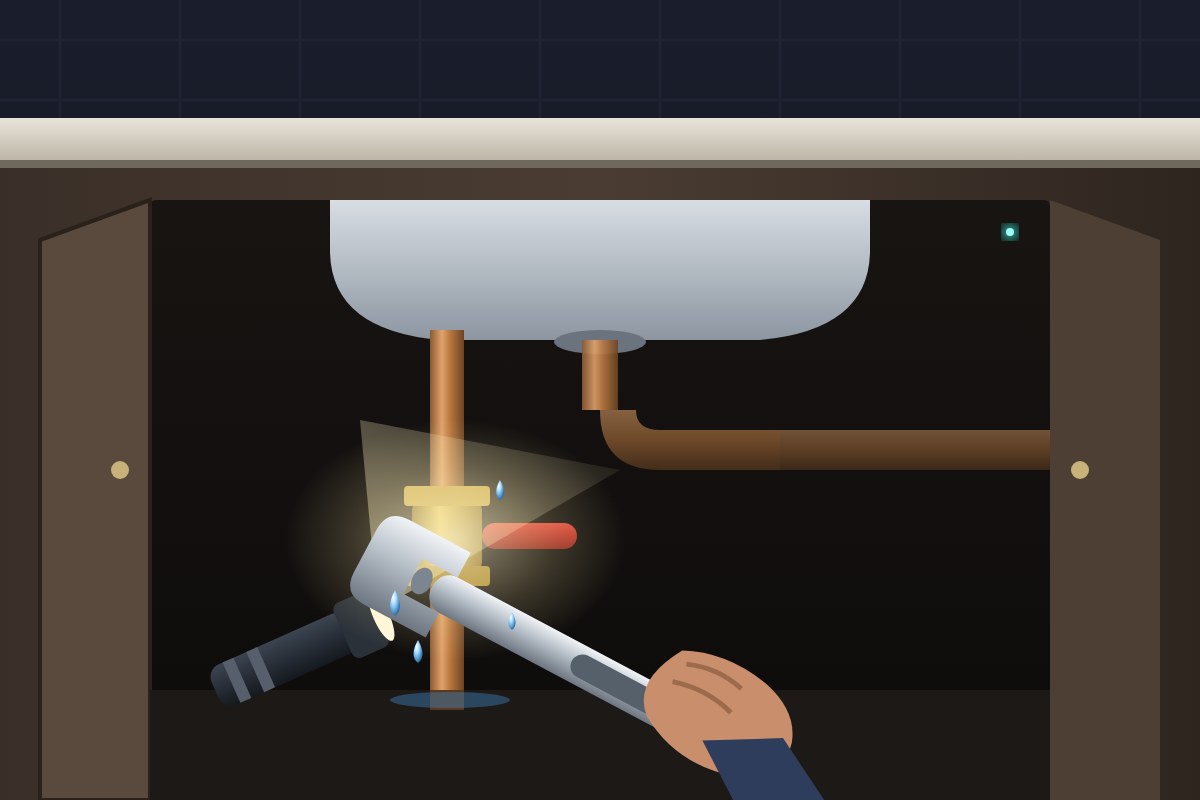
When a call doesn't need redirecting to an emergency number, what matters is what makes it onto the request card before the technician heads out. Five fields, without which every night callout turns into guesswork:
- Address and exact location of the fault (floor, staircase, unit).
- A short description in the caller's own words.
- A photo from the customer, if they can send one right away.
- How to get in — will someone be home, or is a key needed from the building manager.
- Urgency as stated by the customer — without your side promising a specific arrival time.
40 × (1 − 0.30) = 40 × 0.70 = 28 a month.The ratio itself is illustrative — yours may look very different depending on trade and season.
Capturing these five fields up front, instead of the technician asking follow-up questions on the way, shortens the time between the call and the callout and cuts down on misunderstandings about what the customer actually expects.
Service area and a Google listing for a business that travels
A service business that drives out to customers, rather than receiving them at a fixed address, needs a different set of Google Business Profile settings than a shop with a walk-in location.
Address on the listing, or just a service area
Google distinguishes service-area businesses, which visit or deliver to customers and don't serve them at their own address — for these, the address should be removed from the profile — from hybrid businesses, which also serve customers on-site and can keep the address alongside a service area (Google, manage your service area). An emergency service business with no fixed premises, working only at customers' locations, falls into the first category.
Up to 20 areas instead of a radius
Instead of a single radius around head office, Google lets a business list up to 20 service areas by city or postal code, with the outer boundary reaching roughly two hours' driving time from base (Google, manage your service area). A business covering several towns gets one listing for the whole area, not a separate listing per town — Google limits service-area businesses to one profile for the entire territory they cover. There's more on running the listing itself, and on what not to do with customer reviews, under Google Business Profile.
A phone number one tap away: the tel: link
A night request usually starts with one tap on a phone number shown on the website, not with filling in a form. A phone link in the site's code takes the simple form <a href="tel:...">, and on an iPhone it opens the Phone app directly, with no extra steps (Apple Developer, Phone Links).
Where these numbers come from: among 290 Warsaw air-conditioning businesses whose websites we analysed, 213 sites loaded; 61 had no clickable phone number, and 68 had no contact form. That's a measurement of a different business category, not emergency services — but the pattern of a missing clickable phone number on a service business's website shows up often enough that it's worth checking your own site before someone calls at 2 a.m. and can't find the number within fifteen seconds.
The emergency-hotline number is worth placing on the site clearly and separately from the service phone number, so a caller who already knows this isn't a job for your crew doesn't have to hunt for it among the service descriptions. We covered how much missed calls actually cost in a separate article with a formula to calculate on your own numbers.
Who's on duty: schedule, handoff and the customer SMS
A request card with no clear next step is just a note that got written down. Whoever takes the call at night needs to know exactly who to hand it to and how.
Handing the request to the on-duty technician
A duty schedule — who's available which night, in what hours and area — is the foundation without which handoff means calling people one by one until someone picks up. When an on-duty technician is set in advance, the request reaches them right away, complete with address, description and photo, instead of only after a round of phone calls. Duty arrangements and who's responsible each night can be run as tasks with a deadline and an assigned person (Tasks), instead of living in someone's memory or a messenger thread.
The customer who reported the fault should get a confirmation — by SMS or email — that the request was received and passed on. Without a promised arrival time, because nobody taking the call can honestly commit to one at that stage. The same one-queue-instead-of-several-inboxes mechanism is covered in query handling automation.
Do it yourself: a six-step call script
Before anyone builds an automated system for you, the same routine can be run manually by a person on duty:
- Greeting and asking what's happening, in the caller's own words.
- Listening for trigger words: gas smell, smoke, sparking, a person in danger.
- If any of them come up — immediately point to 112 or the right utility hotline, and end the call at this point.
- If none come up — collect the address, description, access details and stated urgency.
- Hand the request card to the on-duty technician according to the schedule.
- Send the customer a confirmation that the request was received, without stating an arrival time.
Two more simple pieces are worth adding: a visible block of emergency numbers on the site (kept separate from the service phone number), and a plain log of night requests — even a spreadsheet — to see how many actually went to an emergency hotline versus how many became jobs. After a month or two, that log shows the real ratio for your trade and location, instead of the illustrative number used above. A similar step-by-step routine for a different on-the-road trade is shown in car workshop automation.
When a system runs the night intake
This same routine can run without a person answering the first call:
- 01Call
- →02words signalling danger
- →03112 or the utility hotline
- →04otherwise a request card
- →05on-duty technician
- →06customer SMS
A system doesn't judge danger any differently than a person on duty: it follows the same list of trigger words and the same rule, with the difference that it also answers when nobody can physically pick up the phone at 3 a.m.
The difference between such an AI agent and a plain chatbot shows up in three process characteristics — more in AI agent vs chatbot. At Aura, that call is answered by AI reception and telephony — it understands speech, recognises the trigger words, and in every other case logs the request and passes it on with a summary and a recording of the call. Collected requests land in CRM and automations, where phone, form and other channels meet in one place instead of separate inboxes, and the confirmation to the customer goes out as one of the Automatic messages. The system doesn't promise an arrival time and doesn't replace the decision about whether a situation is dangerous — it sticks to the rule agreed on beforehand.
Frequently asked questions
Can I decide myself that a situation isn't dangerous?
Better not to rely on your own judgement over the phone. Stick to a pre-agreed list of words and situations that automatically route the caller to 112 or the relevant utility hotline — the exact wording of that rule is worth checking with a lawyer or whoever handles health and safety at your company.
How is 992 different from an ordinary call to my business?
992 is the gas network emergency line, covering the gas distribution network and situations of direct danger, such as a gas smell. A fault in a customer's own gas appliance, with no gas smell or other danger signs, is usually an ordinary service request for your business, not a matter for the network hotline.
Should I remove the address from my Google listing if I only visit customers?
If you serve customers exclusively at their location and don't receive them at your own address, Google recommends removing the address from the profile and setting a service area instead. If you also serve some customers on-site at a fixed address, you can keep the address alongside the service area.
How many service areas can I set in a Google listing?
Up to 20, defined by city or postal code, with the overall boundary reaching roughly two hours' driving time from your base. A service-area business gets one shared profile for the whole territory it covers, not a separate profile per town.
What should be on a night request card?
The address and exact location of the fault, a short description in the customer's own words, a photo if available, information on how to get in, and the urgency as stated by the customer — without promising a specific arrival time at this stage.
Does an automated intake system replace a human judging danger?
No. The system follows the same pre-agreed rule as a person on duty — it recognises the words and situations that route a caller to an emergency number, but it doesn't judge danger on its own or make medical or legal decisions on the caller's behalf.